

Recent headlines have shone an unflattering light on some of Britain’s takeaway establishments, exposing alarming failures in hygiene and safety. This isn’t just a problem for rogue businesses – it’s a wake-up call for the entire food sector and those tasked with regulating it. Consumers place trust in the meals they order, which means there is a clear and urgent need to tighten standards and make sure businesses have the right resources to maintain them.
Hygiene failures that can’t be ignored Inspections from the Foods Standard Agency on takeaway outlets across the UK has revealed a number of alarming hygiene breaches. Among the offenders were establishments infested with pests, food stored under unsafe conditions, and an all-round failure to meet basic cleanliness standards. Such failings compromise both public health and confidence in the food industry at large.
While it’s easy to pick on individual businesses, what these cases really illustrate is a problem at the wider systemic level. Local authorities and environmental health officers are overstretched, with too few resources to effectively enforce standards. Inconsistent inspections, coupled with a lack of follow-up for prior breaches, create gaps that dishonest operators can exploit.
To make matters worse, poor food hygiene may lead to dire consequences for the consumer. Foodborne illnesses aren’t simply an inconvenience; they can result in serious health complications, hospitalizations or worse.
Technology as a force for change
It’s not all doom and gloom; solutions do exist. Technology can play a pivotal role in helping businesses carry out and maintain high safety standards. Automated digital platforms allow businesses to digitize their compliance processes, making it easier to adhere to regulations and keep detailed records of hygiene practices.
Process compliance platforms can provide visibility in real-time for everything from cleaning schedules to the temperature at which food is stored. Businesses can rest assured that nothing falls through the cracks with automatic alerts and reminders. Comprehensive reporting tools also give inspectors the ability to identify problem areas and take quick corrective action.
Facilities and process management solutions to the rescue
Facilities management and process compliance tools can alleviate hygiene concerns. They allow organizations to manage maintenance schedules, check inventory, and remain compliant. More control over everyday operations is ensured by maintaining regular equipment servicing, resolving maintenance issues promptly, and using real-time monitoring to keep establishments clean and safe at any given moment.
These solutions also provide neat integrations with food safety protocols that enable businesses to track activities concerning hygiene and prove compliance to inspectors. They automate cleaning routines to create very comprehensive audit trails, placing owners in full control while mitigating the possibility of human error at the same time.
Education and training are paramount
While technology has certainly served to enable, the foundation of any truly successful food safety program is education. Business owners and staff need to understand the significance of hygiene. They should be equipped with the knowledge to make informed decisions, supported by regular training, clear guidance, and a culture that prioritizes food safety over shortcuts.
The pressure to remain afloat means training often falls by the wayside. It’s here where partnerships between regulators, technology providers, and the industry can come into their own. By providing accessible, practical solutions to training, even the smallest of businesses have the opportunity to comply with standards.
A call for stronger oversight
The government and local authorities must also step up to address the shortcomings in oversight. They should encourage the use of process compliance platforms to ensure hygiene standards are adequately maintained. Increased funding for inspections and harsher penalties for repeat offenders would send a clear message that poor hygiene will not be tolerated. Greater transparency, such as mandatory display of hygiene ratings, can empower consumers to make informed choices and incentivize businesses to prioritize cleanliness.
A shared responsibility
The challenge of better food hygiene mustn’t rest on regulators or business owners alone. It’s a shared responsibility between technology providers, consumers, and public health advocates, all of whom can help raise that bar. With more insightful systems, education, and accountability for businesses, we can truly make food a safer and more trustworthy sector.
Fast food businesses must evolve by introducing process compliance platforms to both maintain hygiene standards and ensure long-term compliance, and now is the time to act.
The shocking stories that have surfaced in recent weeks must become the exception rather than the norm. By doing so, we can safeguard consumers, support responsible businesses, and rebuild trust in the food we buy.
Safe & legal logbooks are the bedrock of any compliance regime and are filled out for hundreds of specific purposes by most employees on a daily basis. But this is an expensive, people intense process that is difficult to manage, open to misinterpretation and full of easy to ignore processes. Consequently, measurement and reporting is difficult, as is the validation of compliance.
In short, this is a system that your good results exist in spite of, rather than by design.
But there is another way. A smart, digitized logbooks solution can provide enhanced, agile and constantly monitored processes and enable you to show continuous compliance with safe & legal requirements. Through process management and data gathering mpro5 can improve productivity, generate cost savings and mitigate business risk. Ultimately, this will come together in an elevated customer experience.

Creating a memorable and exceptional experience
If you are reading this article, there’s a good chance that you spend much of your time working towards creating a memorable and exceptional customer experience. Retail is a market full of competition, and it’s the quality of the shopping journey more than anything else that makes your business stand out from the competition.
To deliver this, your foundations have to be solid, and that’s why compliance is crucial to your efforts. Getting your safe & legal processes right, and being able to demonstrate these, allows you to build trust with your customers and keep them and your teams safe.
Wrestle back control
You may well be burdened with a mixture of traditional paper logbooks and databases or legacy systems that manage your analytics and reporting. This disconnect between the point of data capture and your back-office results in double data entry, mistakes and time-consuming busy-work.
Logbooks can be backdated, filled in incorrectly or forgotten about altogether. Your ground teams are always busy and filling them out is not always convenient in the bustling retail environment.
But the fundamental issue with this system is the lack of visibility and control. Few people in store have any easy oversight of operations, reporting is slow and audits can become incredibly stressful as managers do not have a clear idea of exactly how they will perform.
The prospect of remodeling such a complex and business critical process, regardless of how ineffective it might be, can appear daunting. Compliance can often feel like it controls your operations, but with a digital solution you can wrestle back control and leverage this data to change processes for the better.

Development to adoption
We’ve spent the past decade working with one of the world’s largest supermarkets and some of Britain’s biggest retailers on just such a solution, implementing a fully digital works management system that handles all safe and legal processes, guiding teams through each step and gathering data that can be analyzed for invaluable insight and to improve operations.
Working closely with our clients, we have gradually implemented tailored workflows, smart data gathering and dynamic dashboards and reporting. From development to adoption and refinement, we can bring extensive knowledge and learning from our work with these clients to you in our offering.
Our clients have told us that they can now spot trends, identify pain points and change cultural behavior, while also massively increasing efficiency. Compliance is now a proactive process of improvement, rather than a passive burden.
One of the world’s largest retailers and our oldest retail client, were able to streamline their processes to such a large extent that they have reduced the number of daily checks carried out by 63%.
Drive productivity gains and cost savings
This control over your safe & legal regime comes from dynamic data that drives change in the areas that really matter, fostering a culture that is empowered to evolve with minimal friction. Custom dashboards can be made for every department that show relevant and real-time information on compliance, allowing you to react to issues before they become more serious and to easily see the full picture at a press of a button.
Cutting down on duplicated checks and streamlining workflows will create substantial increases in efficiency. As mentioned previously, one of the world’s largest retailers was able to reduce checks by 63% through adopting mpro5. Our platform is used for over 160 workflows, across 3,000 sites and by 130,000 employees every day.
Your back-office teams will also be able to focus on more important tasks because the data they need will be in the correct format, confirmed with date and time stamps, for easy reporting that can be more detailed than was possible before.
Clear workflows, irrefutable data, a single source of the truth and easy reporting. Digitizing will save you money and time that you can spend on honing your operations and delivering the customer experience that you want to be known for.
If there’s one thing trickier than managing employees, it’s managing subcontractors. It’s a familiar problem for facilities managers who have to rely heavily on an army of specialists, engineers and maintenance teams to manage their buildings and keep them safe and operational.
It may seem that there isn’t any elegant solution to this problem – you’ve got to provide training, check job progress, sort out payments, make sure work is evaluated, keep track of bookings – it’s a ton of admin and then more skilled work on top of that.
It probably means you have a crowded help desk connecting your own CAFM (Computer Aided Facilities Management) to your subcontractors.
Ideally, you want your employees to spend their time doing things that computers can’t – assessing work, evaluating value for money, providing training or planning, not chasing jobs and sending reminders.
Superglue
The challenge is seamlessly bridging the gap between your own system and your third-parties, who may also have their own widely differing ways of working. It’s like finding a pair of one-size-fits-all boots that are also good for running in, and are a pair of clogs.
But much like superglue – the right software can stick your system to any other, giving you consistent data and working for every sub-contractor you use.
You won’t need nearly as many people from your estates wasting time holding it all together and they can focus on the really important tasks on your estates.
Works management for subcontractors
This kind of software is known as ‘middleware’. It bridges the gaps between applications, tools, and databases to provide services to users. It can also be used to link newer applications to older legacy systems.
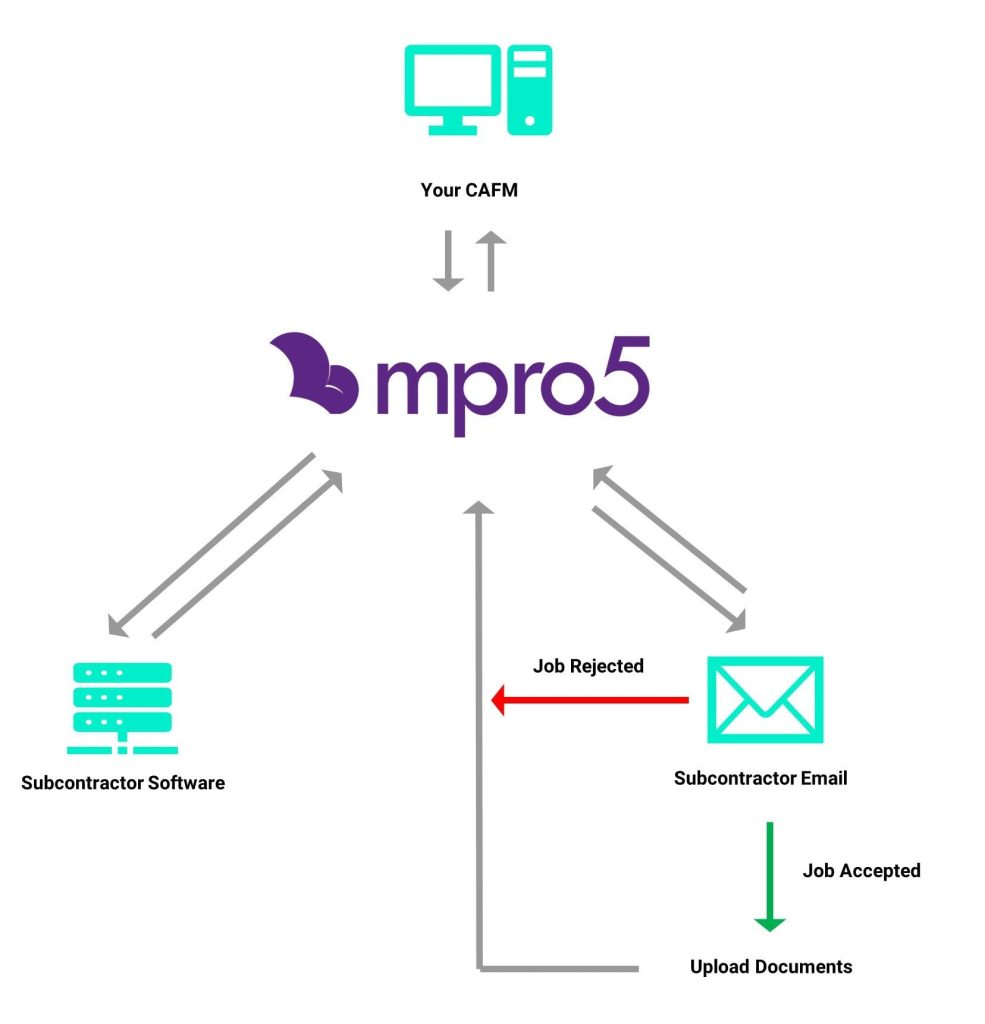
Middleware will plug into your CAFM system, via an open API or any number of perfectly acceptable lower tech (and cost) alternatives. It works by pulling out all the job data and selecting only the relevant information that will allow a subcontractor to pick up that job and pull it into their own system. The software can see when the subcontractor has booked a job in and pull back this info to update your version of the job, without an endless stream of emails than need to be manually handled.
Scalable horses for any-sized courses
At this point, you may be wondering if your organization is really large enough for such a solution, or if it’s too big to pick anything other than a proprietary system. If you’re a modest high street dental practice allocating around ten jobs a week to subcontractors, save your money: a simple spreadsheet will suffice.
But once the spreadsheet stops being enough, it’s time to start looking for a solution that’s scalable – both in terms of cost and scope. Whether you’re a forward thinking NHS department, looking for a system wide solution, or a massive supermarket handing out 35,000 jobs a day, the solution is the same: find a configurable platform.
A configurable and scalable software option can be far more budget friendly than a large custom-built solution, and still with a look and feel designed for you.
You simply don’t need software that’s entirely built from the ground up for your operation: it sounds good on paper, but this is usually costly, inflexible and difficult to adapt to changing circumstances. Flexibility, scalability and integration should be your criteria.

Tried and tested
So, how do we know this approach works and what does it look like in practice?
Let’s take a look at our own software (of course) working in Coventry & Warwickshire Partnership Trust (CWPT).
In this case, they are using mpro5 as their work management platform of choice. It automatically hands jobs out to the right sub-contractors, receiving job updates and related paperwork back – without a single integration needed.
They now use mpro5 to efficiently manage all 110 sites.
It automates much of the work that would otherwise have to be done manually, assigning jobs to subcontractors and sending the request by email. These contain all the necessary details and gives them the option of either accepting or declining the job. If the job is declined, it’s automatically returned to the trust to be assigned to someone else. Once accepted, it will then automatically chase for updates for you too.
Now that staff no longer need to spend hours on the phone chasing subcontractors, the trust has been able to reduce the number of people operating the helpdesk from nine down to three. Freeing up 6 people to get on with more productive tasks within the department.
Manage in the middle
The question is: wouldn’t it be better if your CAFM and the software your subcontractors use could be connected – removing the manual intervention that your systems are meant to eliminate? How about one that can act as both a go between and a holistic works management platform for those subcontractors who don’t have any system in place?
If you’re spending a disproportionate amount of time managing your subcontractors, why not let the computer take some of the strain? You don’t need to throw budget at a bespoke solution, just find configurable platform that can grow with you – because middleware might be the super glue to your operations.
Find out more…
Visit our Facilities Management Page for more content
Hurricanes are among the most devastating and unpredictable natural disasters, and when they hit, facilities managers (FMs) are the unsung heroes who rise to the occasion. They are often the first line of defense, responsible for managing everything from immediate safety concerns to long-term recovery efforts. Their ability to anticipate, react, and respond swiftly is crucial to safeguarding buildings, ensuring the well-being of occupants, and protecting valuable assets.
As we look at the immense challenges hurricanes bring, it becomes clear that facilities management teams need more than just recognition—they need the time, space, and resources to address the damage effectively. Facilities managers are not just solving short-term problems; they are crafting long-term strategies that build resilience and reduce future risks. In this detailed exploration, we’ll highlight how facilities managers are dealing with hurricane damage, the tools they use, and why their work deserves more support and resources.
The Role of Facilities Managers in Hurricane Recovery
Structural Damage: The Front Line of Defense
Hurricanes wreak havoc on building infrastructure with extreme winds, flooding, and debris, often leaving significant damage in their wake. Facilities managers are tasked with assessing and prioritizing repairs to ensure buildings are safe and secure. From roof damage and broken windows to water infiltration, these professionals are responsible for addressing a wide range of structural issues.
Facilities managers do more than just repair—they work proactively to ensure buildings are stronger and more resilient after each storm. They analyze vulnerabilities, fortify weak spots, and plan upgrades to minimize future risks. The level of expertise and foresight required to do this effectively is substantial, and it underscores the importance of giving FMs the resources and time they need to carry out these vital tasks.
Recognition Moment: Facilities managers often work around the clock after hurricanes hit, juggling multiple priorities to get facilities back online. Their expertise ensures that repairs are done right, not just quickly.
Business Disruption and Downtime: The Unsung Role of Recovery Coordination
When hurricanes strike, business operations often come to a grinding halt. Whether it’s due to power outages, structural damage, or restricted access, facilities managers play a key role in minimizing downtime and getting businesses up and running again. Their role goes far beyond fixing buildings—they are integral to restoring normalcy for organizations.
Facilities managers coordinate the recovery process with meticulous precision. They ensure that power is restored, communication systems are functional, and access points are secure, allowing employees and clients to return safely. This level of coordination is a monumental task, yet it often goes unnoticed. By providing FMs with the resources they need—backup generators, robust communication systems, and access to emergency services—we empower them to mitigate business disruptions and reduce the financial impact of a hurricane.
Empowering Action: Businesses should invest in their facilities teams by equipping them with advanced technology and tools to manage crisis situations, ultimately ensuring quicker recovery and reduced financial losses.
Health and Safety Risks: Safeguarding People and Property
Facilities managers are the guardians of health and safety during and after a hurricane. Hurricanes introduce serious safety hazards: flooding can lead to mold growth, electrical systems can be compromised, and structural weaknesses can pose dangers to anyone in the building. Facilities managers are on the front lines, working to ensure that these risks are identified and mitigated as quickly as possible.
They oversee post-hurricane safety inspections, checking for hidden dangers like water damage, fire hazards, or unstable structures. FMs are also tasked with coordinating evacuation protocols and ensuring buildings meet safety regulations before reopening. Their responsibility in safeguarding the health of occupants can’t be overstated.
Highlighting Impact: Facilities managers save lives by ensuring that buildings are safe to re-enter. Their dedication to these tasks is invaluable and often goes unrecognized, but their role is critical in creating safe environments post-disaster.
HVAC and Utility System Damage: Restoring Critical Infrastructure
After hurricanes, key systems like HVAC, plumbing, and electrical utilities are often severely impacted, threatening to shut down entire operations. Without these systems, buildings become uninhabitable, and business continuity grinds to a halt. Facilities managers not only assess the damage to these systems but also oversee their repair and restoration.
The complexity of managing these systems post-hurricane cannot be underestimated. Facilities managers need access to detailed system records, preventive maintenance data, and specialized contractors to ensure that critical infrastructure is restored efficiently. Their ability to manage these intricate systems highlights the importance of giving them the time and resources necessary to do their job properly.
Resourcing FM Teams: Investing in preventive maintenance and ensuring that facilities managers have access to specialized resources, such as emergency contractors, ensures quicker recovery for essential building systems.
Grounds and Landscaping: Clearing the Path to Safety
The damage hurricanes cause is not confined to buildings alone. The grounds surrounding a facility, including landscaping and access routes, are often littered with fallen trees, debris, and other hazards. Facilities managers must coordinate efforts to clear these areas, ensuring that entrances are accessible, and the grounds are safe for anyone entering the facility.
By prioritizing debris removal, FMs prevent secondary incidents like vehicle damage, accidents, or blocked emergency exits. In the long term, they also make decisions about sustainable landscaping practices, planting resilient vegetation, and designing drainage systems to handle flooding.
Praise Point: Facilities managers don’t just focus on what’s inside the building—they ensure the entire facility is functional, from the front door to the back gate. Their wide-ranging responsibilities demonstrate their versatility and dedication to safety and recovery.
Financial Implications: Navigating Insurance and Claims
The financial burden of hurricane damage is enormous. Facilities managers are often tasked with managing the complicated web of insurance claims, repair costs, and long-term restoration efforts. This is no small feat—FMs must meticulously document damage, manage contractors, and navigate rising insurance premiums.
With access to the right tools, facilities managers can expedite insurance claims, reducing delays in receiving the funds necessary for repairs. Their ability to manage the financial complexities of hurricane recovery highlights the need for businesses to give them both the time and resources to do their job effectively.
Financial Recognition: Facilities managers save organizations money by efficiently navigating the insurance landscape and finding cost-effective solutions for repairs. Their expertise in this area should be acknowledged and supported.
Environmental and Sustainability Concerns: Leading the Way to Safe Recovery
Hurricanes often result in environmental hazards, from chemical spills to water contamination. Facilities managers play a key role in ensuring that the recovery process doesn’t exacerbate these risks. They oversee the clean-up of hazardous materials, ensure compliance with environmental regulations, and implement sustainable practices that minimize the long-term environmental impact.
By prioritizing eco-friendly recovery methods, facilities managers help organizations meet their sustainability goals while ensuring that the recovery process is as safe as possible.
Sustainability Highlight: Facilities managers are environmental stewards, making decisions that not only address immediate risks but also promote long-term sustainability and compliance. Their role in safeguarding the environment deserves recognition and support.
Long-Term Recovery and Resilience: Preparing for the Future
The work of a facilities manager doesn’t end once the immediate damage is repaired. Long-term recovery and resilience planning are key components of their role, ensuring that facilities are better prepared for future storms. Whether it’s upgrading building materials, installing flood-resistant systems, or fortifying critical infrastructure, facilities managers are constantly thinking ahead.
Facilities managers use advanced tools, like facilities management software, to streamline recovery efforts, track repairs, and create workflows for ongoing improvements. These tools help them manage complex recovery processes while also planning for future hurricanes. To support them in this role, organizations must give them the space and resources to implement long-term resilience strategies.
Forward Thinking: Facilities managers are visionaries who plan for the future while addressing the present. Their ability to craft long-term strategies ensures that facilities are better prepared for whatever comes next.
Conclusion
Hurricanes pose enormous challenges, but facilities managers are the backbone of recovery efforts, ensuring that buildings, people, and operations are protected. Their work is multi-faceted, requiring not just technical knowledge but also strategic thinking, coordination, and leadership. As organizations face increasing risks from natural disasters, it is essential that we provide facilities managers with the resources, support, and recognition they need to succeed.
Facilities managers do more than just react—they build stronger, more resilient facilities that can withstand future storms. By investing in their teams, providing them with the necessary tools, and allowing them the time and space to focus on comprehensive recovery efforts, organizations can not only minimize the impact of hurricanes but also emerge stronger and more resilient. Facilities managers are the unsung heroes of hurricane recovery, and by giving them the recognition and support they deserve, we ensure that our businesses, communities, and infrastructure are well-prepared to face future storms with confidence.
In the end, it’s not just about repairing what’s broken; it’s about building something better, stronger, and more resilient—and facilities managers are leading the way.
Coming to terms with the regulatory framework of the food industry is no simple feat. With new and emerging standards and regulations in food safety, this puts pressure on any business operating within the industry to remain compliant without compromising efficiency. For producers, distributors, or sellers of food, one major problem that always persists in the industry is regulatory compliance. Fortunately, digital tools can ease the burden of keeping up with these requirements, including process management software. These solutions have a knack for making compliance manageable, efficient and cost-effective.
The challenge of regulatory compliance
Compliance in food manufacturing is not simply a ‘tick-box’ exercise; it is very much at the heart of public safety and the reputation of a company. If a business fails to conform to the set standards by the regulatory bodies, huge fines are involved, loss of credibility incurs, and in worse cases, it may even be ordered to shut down. Food safety laws, such as HACCP guidelines, should be followed strictly to minimize risks. The process involves a lot of heavy documentation, prompt reporting and taking necessary steps to considerably reduce the chances of contamination or any mechanical failure.
However, nearly all manual processes lead to human errors, missed inspections, or partial documentation that rapidly erode compliance. This is where process management platforms lend a helping hand.
Using food safety software
Today, food safety software automates many of the tasks that a food business traditionally has to do. One-stop recording, monitoring and management of critical safety data, from tracking food handling processes to hygiene standards, are a few services offered by these platforms.
This type of software enables an enterprise to comply with the standards required in ensuring complete food safety, as outlined by HACCP for instance. It can be programmed to automatically notify workers when safety checks should be performed, record temperature readings, or document cleaning schedules. On top of that, it ensures that everything required is done on time and logged digitally for audit purposes. Having this automated reporting in place reduces the chances of missing an important detail, which would usually form the basis of a compliance breach, thus saving the businesses from unnecessary penalties.
Facilities management & planned preventive maintenance
Food safety compliance enactments largely deal with the proper maintenance of facilities, either production or storage, where food is dealt with. An equipment breakdown has the potential to not only delay the operations, but also create unsafe conditions against safety enactments.
Facilities management software becomes very valuable in this respect as it allows a food business to manage maintenance tasks efficiently. It can be integrated with a computerized maintenance management system to ensure that there is periodic servicing of equipment and that appropriate measures to prevent breakdowns are taken. The schedules for PPM are set within the system, which alerts businesses when equipment is due for servicing. This lowers the risk of unplanned downtime and ensures that all machinery is operating at its optimum safety level – this is crucial from a regulatory compliance perspective.
Quality management system: Why it matters
Other than equipment maintenance for ensuring food safety, food businesses need a general quality management system that guarantees consistency and compliance. QMS provides the perfect forum for the harmonization of processes and improvement in product quality, helping to sustain regulatory requirements.
Utilizing process management software for your QMS will provide companies with better control of their operation. Be it ingredient quality inspection or monitoring of production processes, the system can make sure the best standards are pursued at every level in the supply chain. This helps to maintain regulation compliance while also building a sense of trust among customers.
Digital platforms & proactive compliance
Food industry regulations require constant updates, but this doesn’t necessarily have to mean constant stresses. Merging food safety software, facilities management software and a QMS on an integrated platform enables businesses to be compliant in a proactive way.
Nowadays, food safety is top of the priority list, and therefore, investment in the right process management tools cannot be stressed enough. Rather than waiting for inspections to show the gaps in processes, digital platforms enable food businesses to monitor and manage their operations nonstop.
This real-time oversight cuts risks of compliance breaches, improves operational efficiency and gives peace of mind to businesses needing to meet the latest regulatory standards.
Today I want to talk about the importance of digitalization in QSRs (Quick Service Restaurants) – the customer experience. If you read about this online, you might get the impression that the only thing QSR’s are focused on is ensuring shorter lines, installing big touch screens and minimizing interaction with staff.
Being able to order delivery from an app or pick-up-and-go is great, but this 99% focus on digital tools for customers misses a key point. If we are talking about the customer experience, we should look at what that journey is like, and not just how they got there.

Serving the senses
Think about the last time you dined out, or maybe just grabbed a coffee. Whether you remember the rich scent of coffee beans or the incredibly uncomfortable chairs, your senses worked together to create that experience, and things that stand out, good or bad, stick in your brain for a long time.
The Peak End Rule
In particular, it’s the last memorable stimulus that really defines the experience. This is known as the Peak-End rule: people judge an experience based on its most intense point, and its end.
Ideally, you want this peak experience to be the great taste of your food, a friendly member of staff being helpful and the inviting atmosphere.
But, have you ever been into a Costa and felt it was too noisy, or a Nando’s that was too warm, or a McDonald’s that was too bright (metaphorically speaking).
In short, ambient conditions in QSRs matter and this is a critical factor in your decision to come back for more.

Did you know?
As you may well know, I’m a sales guy with a focus on digital solutions in retail and hospitality. I’m always trying to work out what value I can bring to a business and recently, to QSRs in particular.
What stands out to me is the evidence of just how potent the ambient conditions can be in a customer journey. For example, there is evidence to suggest that loud noises can suppress your sense of taste, and that the ambient light and temperature can influence buying decisions as well as whether a customer returns to the restaurant.[1]
Taking stock
It’s worth mentioning that there are also more straight-forward but important things to consider: we’ve all used a restaurant bathroom only to discover there is no soap or, worse still, that there is no toilet paper roll – this is definitely a Peak End experience.
You need to be on top of your stocks of consumables, emptying trash bins and wiping down tables, because we all know these can pretty quickly poison the customer experience if it’s not done right.
But on those days when your store is rammed, it can be challenging to balance serving customers and cleaning your bathroom, so how can this be managed?
Controlling your customer experience
Much of what I’m saying is, in a way, no news to QSRs – they know what kind of atmosphere they want to ideally create. The question is: how can you monitor these conditions, account for factors outside of your control such as the weather, and get data back on every site?
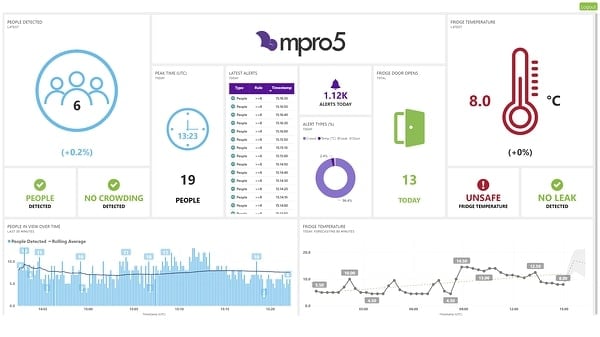
Where there is a will (or more accurately a sensor), there is a way. Using remote monitoring sensors, you can see everything: lighting levels, noise, temperature and even air quality. These sensors can be connected to your software platform of choice and provide continuous readings through a dashboard. Ideally, you want dashboards for individual sites as well as regional and national overviews.
You can even use sensors to monitor how full your trash cans are, if the bathroom has enough soap, and how many times it has been used over a given period.
What’s more, you can use this data to trigger tasks for staff to complete and send them by email or through a process management app. Automatically let a site know that they need to open a window, turn the music down or put some toilet paper in the bathroom!
The big picture
The benefits of this system go beyond collecting this data in isolation. Bringing this data into your smart platform of choice, you can surface the data in the aforementioned dashboards and generate reports with relatively minimal effort.
If your smart platform is properly integrated into your tech stack, you’ll be able to compare this data with sales numbers, logbook data (you’ve digitalized this right?), weather information or even macro market data. Only then will you start to get the full picture: properly structured data will encourage and facilitate greater insight into your business, what really has an impact on your customers and what decisions you can make to take your business forwards.
There’s a lot more to digital transformation than being able to order a steak using your phone. It’s about collecting data and what you do with that data to make your customer experience memorable for a good reason rather than a bad one.
References
https://en.wikipedia.org/wiki/Peak%E2%80%93end_rule
https://www.troldtekt.com/news/themes/restaurants/sound_and_taste/
https://blog.1000bulbs.com/home/the-importance-of-restaurant-lighting
[1] All links are at the bottom of this article