

Food service providers face a tough challenge when it comes to food safety compliance. They must not only meet the same uncompromising food safety standards as restaurants but also overcome additional complications.
The toughest of these is arguably ensuring the safe transportation of prepared food and ingredients at the correct temperatures. This is closely followed by having to work in unfamiliar venues, sometimes with inadequate facilities.
Many catering firms choose to carry out regular food safety compliance reviews to avoid nasty surprises on audit day.
What does a food safety consultant do?
A food safety consultant can help food service businesses ensure food safety compliance by conducting regular food safety compliance reviews. With in-depth knowledge of relevant legislation such as the Food Safety Act 1990 and the Food Hygiene and Safety Regulations 2013, inspections will be equivalent to the inspections performed under the Food Standards Agency’s Food Hygiene Rating Scheme.
The consultant will consider the suppliers a business works with, procedures for the delivery and unloading of food, and how it’s stored. They will also look at preparation and cooking processes, paying particular attention to hygiene practices, cleanliness, maintenance and pest control, all of which must be documented.

As part of their food safety compliance review the consultant will identify good practices, along with potential hazards and risks and produce an action plan to tackle areas of non-compliance.
Benefits of using a food safety consultant
There are many advantages to outsourcing food safety compliance to a dedicated food safety consultant.
- Time-savings – Contracting a food safety consultant frees managers to focus on other priorities such as revenue generation, secure in the knowledge that they’re complying with all applicable food safety legislation.
- Supports business-getting efforts – Prospective customers are likely to view food safety compliance as a non-negotiable criterion when selecting a new caterer.
- Improved odds – Businesses have a much-increased chance of achieving the highest grades for food safety compliance certification with the benefit of an external consultant’s expertise.
- Saves money – Passing food safety compliance audits first time avoids the cost of repeat audits and the associated business disruption.
- Protects customers – In the catering trade, a simple oversight or mistake can result in illnesses like food poisoning. In extreme cases where allergens are involved, a food safety compliance failure can result in death.
- Protects Staff – Your employees are your most valuable resource, and having frequent safety checks ensures they are protected from making costly mistakes, as well as freeing them from the stress of audits by ensuring a positive outcome.
- Reduced risk of reputational damage – Courts have the power to issue unlimited fines and impose a two-year prison sentence on company directors for serious food safety offences. One of Europe’s largest supermarket’s, Tesco, recently hit the headlines when it was fined an unparalleled $9.56 million for out–of–date food offences at three of its stores.
In summary, a food safety compliance review reduces the risk of unsafe food reaching consumers, minimizes the risk of costly product recalls and helps catering businesses build a good reputation.
In the UK, standards relating to the cleaning of hospitals were last updated in 2007. Now, there are the new National Standards of Healthcare Cleanliness 2021. This new set of standards regulates all cleaning tasks throughout the NHS, regardless of which department is responsible for it.
With these new changes, it’s imperative that you understand the new standards to ensure that you remain compliant. Keep reading to learn more about these standards and how you can ensure you remain compliant.
What is the purpose of hospital cleaning?
Regulation 15 of the Health and Social Care Act 2008 (Regulated Activities) Regulations 2014 requires healthcare facilities to be “clean, secure, suitable and used properly and that a provider maintains standards of hygiene appropriate to the purposes for which they are being used.”
In addition to this, the “code of practice for preventing and controlling infections, and related guidance, states NHS bodies and independent providers of healthcare and adult social care in England must adequately resource local provision of cleaning services. They should also have a strategic cleaning plan and clear cleaning schedules and frequencies so that patients, staff, and the public know what they can expect.”
What regulations must I adhere to?
Within the UK, all medical practices are required to follow the standards as set out within the Health and Social Care Act 2008. This is then monitored by the Care Quality Commission (CQC) to ensure that patients and other users of healthcare facilities remain safe.
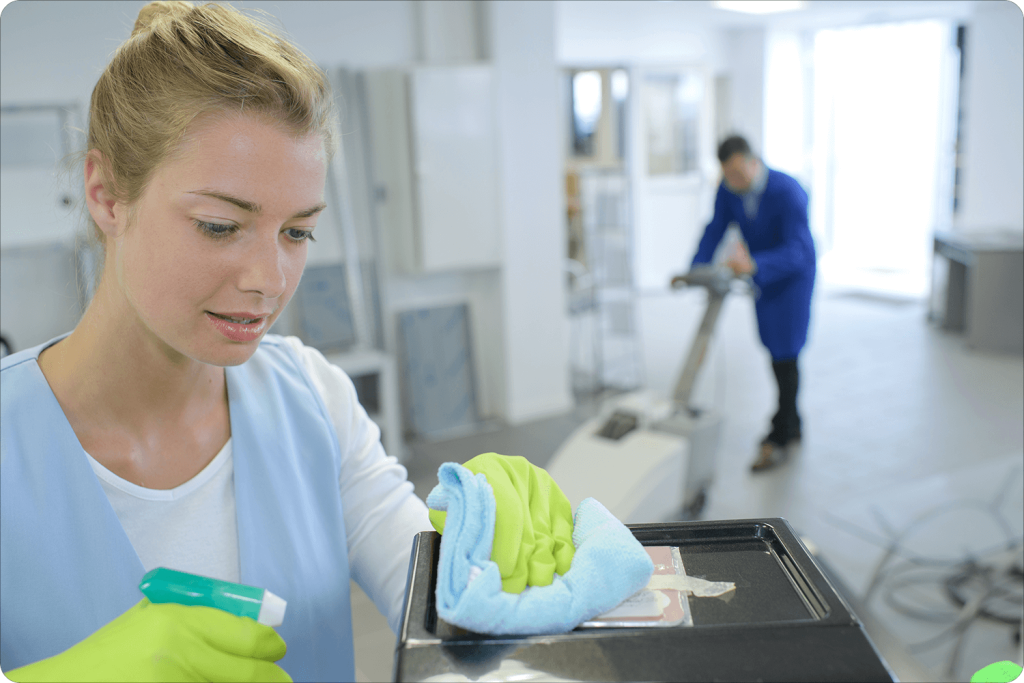
These regulations are applicable to the following healthcare facilities:
- Hospitals
- Clinics
- Hospices
- Doctors
- Children’s services
- Ambulances
- Care homes
- Dentists
- Mental health services
Hospital Cleaning Checklist Example
The NHS has released a National standards of healthcare cleanliness 2021 appendix which demonstrates a suggested 50-point check. However, each organisation or healthcare facility will need to adapt their cleaning checklist to their own needs.
Here are some examples from the list:
- Bed pan (reusable), bed pan holder, patient wash bowls.
- Bed pan washer / macerator.
- Other sluice equipment including sluice sink and equipment holders.
- Commodes.
- Patient hoists.
- Weighing scales including neonatal, seated and standing scales
- Medical equipment e.g. intravenous infusion pumps, drip stands and pulse oximeters, medical gas bottles and stands, walking aids. Refer to local protocol for medical equipment connected to and not connected to a patient.
- Wheelchairs (organisation owned). Refer to local protocol.
- Patient fans – with accessible blade. Refer to local risk assessment and protocol.
- Patient TV and bedside entertainment systems including head pieces.
- Notes and drugs trolleys and patient clipboards.
- All chairs and couches (soft furniture).
- Patient beds – frame, wheels, castors, head, foot, cot sides, nurse call and control panels, including carers beds in the clinical area. Non patient beds including oncall beds – clean as per local protocol.
- Patient bed and trolley mattresses. Refer to local protocol for inspection of mattress integrity and ingression.
- Patient trolleys and treatment couches. Trolleys with x-ray storage and oxygen cylinders clean according to local protocol.
- Patient toys (premises owned). Refer to local protocol and risk assessment.
- Switches, sockets and data points, trunking, handrails and wall fixtures
- Walls that are accessible up to 2 metres.
- Ceilings and walls – not accessible above 2 metres and ceiling lights.
- Floor – including hard and soft skirtings.
The checklist goes on to include other surfaces such as mirrors, bathroom fixtures, radiators, lockers and cleaning equipment.
How can mpro5 help you remain compliant?
Ensuring that the aforementioned standards are met is no easy task. It requires you to ensure that you have provided cleaning staff with the necessary tools to carry out their responsibilities and also ensure that your management staff are able to access the necessary documentation used within compliance checks.
At mpro5, our healthcare management software can help you to navigate these obstacles and ensure that your operations meet the necessary regulations and standards. If you’d like to learn more, get in touch and we’ll be happy to help.
Many believed it wouldn’t happen in their lifetime but the new National Standards of Healthcare Cleanliness are finally here – and only nine years later than promised. Not as long as the film director James Cameron took to make Avatar (15 years if you’re asking) but still quite a wait.
When the previous standards were introduced in 2007 they were meant to be reviewed every five years, which means they should have been reassessed in 2012. Even so, they won’t come into force fully until November 2022.
But they’re here now and, with our heightened awareness of hygiene since the pandemic, are sure to be welcomed by the same people who disinfected their supermarket shop before unpacking it in the early days of COVID-19.
Importantly, the new standards measure not only how often cleaning takes place but also how effective it is. Hospitals are required to publicly display their hygiene rating, much like the hospitality sector’s ‘Scores on the Doors’. The system allows much greater flexibility but is fiendishly complicated. Trusts are required to calculate risk ratings and account for new ‘blended areas’. Armed only with a pen and calculator, this would be a headache. Fortunately, automating the process with intuitive technology makes it a breeze.
So, what’s new with the National Standards of Healthcare Cleanliness?
Trusts must now undertake a Technical Audit that includes a “50-point check”. This covers elements present in most healthcare environments, from bedpans to fridges, that require regular, thorough cleaning.
“What’s the big deal?” you ask – it’s just one more question than the former 49-point check. Not so fast! Much of the checklist is different from the previous check – it’s not just that one extra question has been added.
Trusts must now allocate a Functional Risk Category to each area. This is a crucial first step in applying the new standards as audit levels are tied to the risk factor. Trusts must produce a written justification for the risk category applied and review the rating at least annually or if there’s a major change in clinical activity.
Cleaning frequency of a given item is determined by the Functional Risk (FR) of the room it is in. It makes sense that an armchair in a high-risk area such as Accident and Emergency needs to be cleaned more frequently than a chair in an admin office. There are six FR categories, with FR1 being the highest risk and FR6 the lowest.
Better allocation of resources
Then there are what’s known as ‘blended areas’ – an area that has rooms with different risk categories. The ability to have “blended areas” means you can assess an entire area or section of a site while still reflecting the varying FR categories of different rooms. This gives you greater flexibility and allows you to allocate resources where they’re needed most.
For example, within one functional risk area, it’s possible to assign different risk categories to individual rooms, each with a different target score. An office or meeting room could be categorised as FR5, a staff room as FR3 and in-patient room as FR2. The cleaning frequency for each individual room will be determined by its risk rating, saving you wasting money on excessive cleaning of a relatively low-risk area.
The target for a blended area will be based on the combined targets for the number of rooms in each functional area. The ultimate star rating will be determined by the combined calculated score for the entire blended area or from the score for the highest risk category audited.
Got all that?
Summing up, although blended areas mean audits are less of a blunt instrument, the downside is that they add an extra layer of complexity. Trusts must create an in-depth profile categorising each area so, even if it wasn’t already mandated under the new standards, you will certainly need a digital solution to manage the assessment process – and preserve your sanity.
To find out more about compliance with the National Standards of Healthcare Cleanliness…
Visit our Facilities Management page to read more about we help NHS Trusts adapt to ever-changing compliance.
Technological advancements are continuing to transform the retail industry, with the Internet of Things (IoT) leading the charge. Research shows that retailers are implementing IoT solutions to enhance operational efficiency and improve customer experiences. These technologies can monitor various operational aspects, alerting maintenance teams to issues and providing precise details about their location and nature. Managers are then informed once problems are resolved. As consumer expectations evolve and competition intensifies, embracing IoT solutions is crucial for retailers aiming to maintain a competitive edge and foster sustainable growth.
IoT technology refers to the network of interconnected devices equipped with sensors and software that enable them to collect and exchange data in real time. This connectivity allows for real-time data collection and analysis, leading to significant practical benefits. So, what does this mean in practice? From faster, more dynamic cleaning to better food temperature monitoring, improved crowd and footfall management, and more reliable ways of managing in-store slips and trips, IoT cameras, sensors, and critically, applications that can get the information to workers, are revolutionizing retail.
The latest IoT innovations allow retailers to make informed decisions and respond swiftly to changing conditions. Employees, from cleaners and technicians to security guards and others equipped with IoT process management applications, can quickly and effectively address issues by having direct access to essential information. This seamless integration of technology into daily operations has set new standards for efficiency and customer satisfaction in the retail sector.
Here are some of the many leading uses of IoT that are making significant strides in the retail industry:
Dynamic cleaning
IoT sensors are revolutionizing traditional cleaning practices by allowing for dynamic, needs-based cleaning schedules. In a busy supermarket, sensors can detect high-traffic areas and, by integrating with a process management app, signal cleaning staff to focus on these spots during peak hours. Conversely, deeper cleanings can be scheduled, and recorded, for quieter periods. This approach maximizes efficiency, reduces resource wastage, and ensures consistently clean environments, directly responding to evolving customer needs and operational demands. Cleaning can be verified, audited, and proven to ensure brand standards are maintained and health and safety regulations are being adhered to.
Food temperature monitoring
Ensuring food safety and compliance with regulations is a top priority for retailers. IoT probes provide real-time monitoring of fridge and freezer temperatures, ensuring that perishable items like dairy and meat products are stored at optimal temperatures throughout the day. This continuous monitoring not only mitigates risks but also enhances consumer trust and loyalty by reducing the risk of spoilage and maintaining product quality. If temperatures drop below a set level, alerts can be sent to staff via an integrated app to investigate and resolve the cause or escalate the issue to maintenance if required.
Crowd control
With an increasing focus on safety and customer experience, IoT sensors and cameras play a pivotal role in crowd management. In retail stores, these sensors can monitor the number of customers entering and exiting the premises in real-time. This data allows store managers to adjust staffing levels and manage queues efficiently during peak hours. By tracking customer flow and space utilization, retailers can proactively prevent overcrowding and long queues, optimize space usage, and improve overall customer satisfaction.
Environmental monitoring
Creating a comfortable shopping environment involves effectively managing various environmental factors. IoT sensors enable retailers to monitor lux levels, noise levels, HVAC systems and air quality in real time. This comprehensive environmental monitoring ensures optimal conditions for customers and staff, enhancing the overall shopping experience. Changes to the environment can trigger alerts to staff who can take the necessary action to return the store to its optimal state.
Managing slips and trips
Leveraging advanced IoT technologies, cameras can detect spillages and other hazards in real time. This swift detection allows for timely intervention, reducing the risk of accidents, liabilities and associated costs. Such proactive safety measures are essential in maintaining a safe and welcoming retail environment.
IoT technology is fundamentally changing how retailers operate, providing tools to create more efficient and customer-focused environments. As we reach peak retail seasons having effective in store operations is vital. The capabilities of advancing retail technologies such as IoT sensors are clear, but they are of little value if you can’t act immediately on what the technology tells you. The key to successfully utilizing IoT technology is to maximize its benefit to the bottom line by using the insights to improve operational performance, streamline processes, and deliver a more profitable and efficient business model, ultimately driving higher revenue and customer satisfaction. Those embracing advancements will undoubtedly set new standards for excellence in their industry while laying the groundwork for a more prosperous and sustainable future.
The NHS is under a lot of pressure right now, in case you haven’t heard. Strikes, staff shortages, pandemic backlogs, waiting lists, an aging population – there are many factors at play here, but one key piece is the physical capacity of trusts.
Maximising the use of the primary care estate, moving it closer to communities and relieving strain on acute care centres is an important objective of the NHS Long Term Plan. Organisations such as NHS Property Services have already delivered crucial insight for many trusts, but this hasn’t been adopted consistently at a national level yet.
Individual trusts can use their experience and understanding of their specific local needs in order to better inform data gathering for effective space utilisation projects.
I’ve got a feeling
A lack of data is often the starting point of poor decisions, because people tend to fall back on their feelings when they don’t have the facts. If trusts are going to implement efficient space utilisation strategies, they need to know how their spaces are being used, at what frequency and why.
Clinics are constantly being remodelled, but without a solid baseline understanding, this is not necessarily productive. Trusts risk over-investing in new spaces when they aren’t using their current estate efficiently, wasting money and time.
Long term parking
Kingston Hospital NHS Foundation Trust have been tackling space utilisation recently to significant effect. The trust has been under pressure to expand their parking facilities, but their previous pay and display parking tickets didn’t provide enough data on parking habits. From these tickets, you could tell people had paid for several hours, but not how long they stayed.
Kingston realised that before they built new parking, they needed to establish a baseline that gave them an accurate picture of their parking capacity. Investing in an Automatic Number Plate Recognition System (ANPR) meant that they could understand parking times at a granular level.
What they found was that 60% of cars were parked for less than 20 minutes: the problem wasn’t a lack of parking, but a lack of drop-off and pick-up areas.
Rather than investing millions in a new car park, the trust was able to spend a small amount on new temporary parking zones for pick-ups and drop-offs.
A clinical approach
Keen to replicate their success with parking, Kingston approached us to undertake a wider space utilisation project that focuses on clinic space. There’s a sense in the trust that there are personal offices collecting dust while other clinics are bursting at the seams, but to really know how to progress they need room usage data.
Of course, there are a lot of natural concerns with this approach, no one wants to lose their office, but this strategy shouldn’t override the genuine need for spaces to practice in.
By using Person in Room (PIR) sensors, Kingston can start to measure room usage at the granular level needed to make the right decisions, to understand how and why a space is used, and how departments can work together to make the most of what they have.
Location and perspective
While this is just the start of a specific project with Kingston, other trusts should pay attention to this approach due to the potential for insightful comparisons.
Once you have mapped out your estate and the usage of each space, you can compare this with financial data to find out what your spend per square foot is, where you could be saving money by combining spaces, or providing a better service by separating them out.
Technology unlocks spaces
Of course, we aren’t the only ones helping trusts to make the most of their space. Flexible room booking systems are becoming increasingly common, as are initiatives to share spaces and consider the community and care impact of local clinic space.
It’s cliched to say that the NHS is in crisis – we already know that the expectation is big and the pressures on it are substantial, even existential. But this is also an opportunity for trusts to embrace innovative technology to tackle estate efficiency, whether that’s smart mobile works management, the use of intelligent sensors, or smart booking systems.
Those trusts that approach these old problems with an open mind to novel approaches will succeed in cutting their spending and improving service for patients. Those that don’t start working on this soon will struggle.
You might like…
Here are some other blogs you may find helpful:
Why Data is the Key to a Successful Facilities Contracts
Tapping into your data is the secret to Innovation
NHS Asset Management: When is it time to throw in the towel?

This article originally appeared in Food Service Equipment Journal.
The UK Health Security Agency reported that a member of the public passed away from the E. coli outbreak in June, and this year there have has been 288 confirmed cases of E. coli to date in the UK, with 49% being admitted to hospital. Sam Roberts, food retail lead at mpro5, discusses the digitised platforms caterers can implement to manage, log and track food safety reporting, in a bid to reduce the risk of more E. coli outbreaks and protect customers…