

Complete records aren’t proof. On-time checks are.
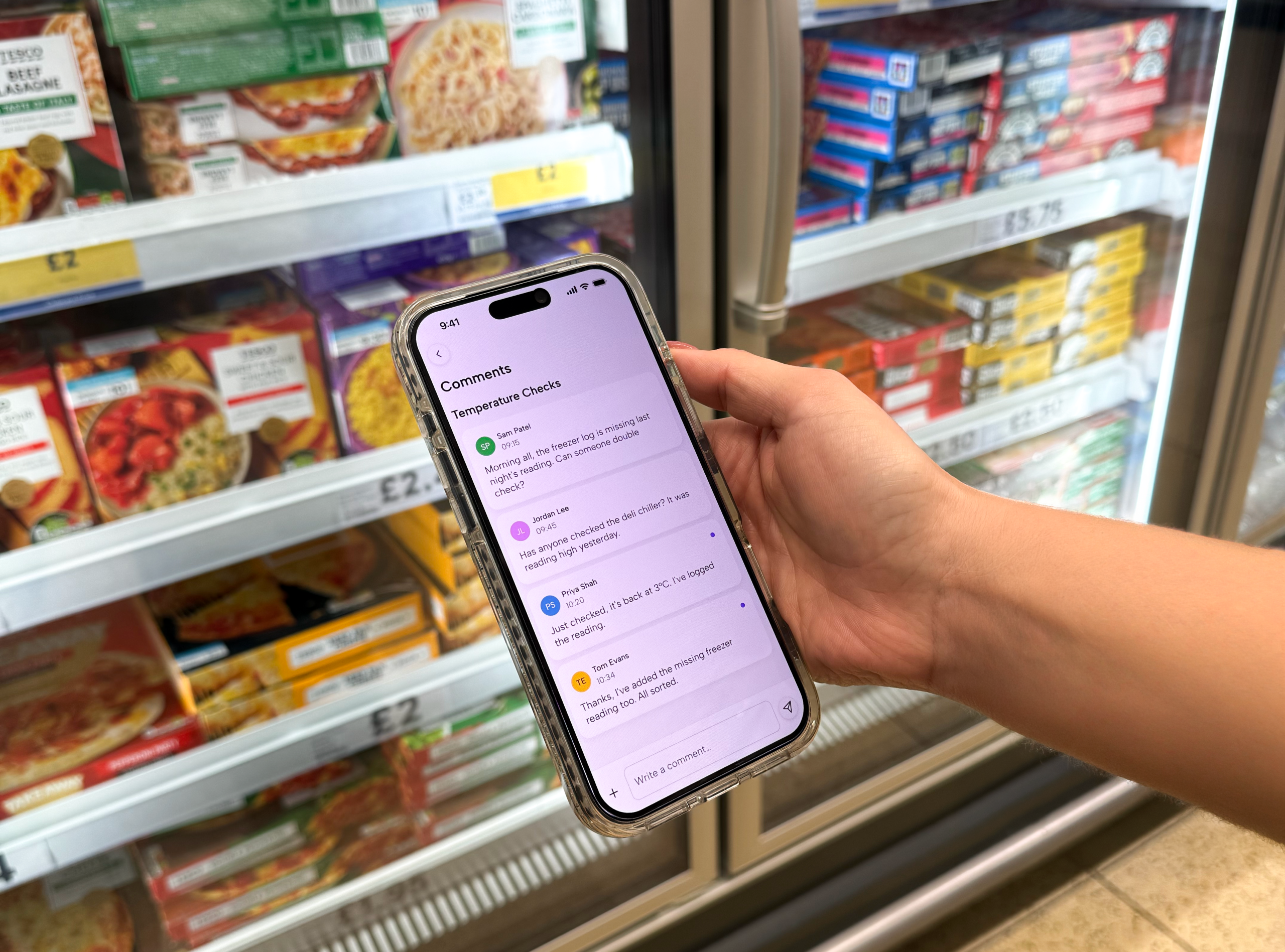
A chilled food producer we spoke to recently discovered something that would have been almost impossible to spot on paper.
Their end-of-day fridge check was being completed at 2pm.
Nobody was deliberately cutting corners. The production manager on the early shift had a quiet hour after lunch, so they got the check out of the way.
On paper, everything looked right: temperature in range, box ticked, signature there.
The problem? A fridge check completed at 2pm only proves what was happening at 2pm. It tells you nothing about the hours that followed, the final production run or the night ahead.
They only discovered it because they’d moved the check onto a phone. The timestamp exposed what the paper record couldn’t.
And that’s the problem with a lot of food safety records. A completed check doesn’t necessarily mean the control worked as intended.
During the festive production peak, that distinction becomes even more important.
Christmas doesn’t create weak controls. It exposes them.
For many food producers, November and December bring bigger orders, longer production runs, seasonal lines and additional shifts.
They also bring more agency and temporary staff, sometimes starting on a Monday and working a line by Wednesday. It’s why the Food Standards Agency highlights seasonal staff training and allergen information in its festive guidance for food businesses.
At the same time, the people who know your processes best are stretched.
One drinks producer told us that, on a particular line, only two of eight people could run it and complete the necessary checks. When one of those people was off, the checks still needed to happen. But responsibility could quickly fall to whoever was available, relying on memory and fitting checks into whatever gap appeared.
Then there are handovers.
The chilled food producer above runs a long shift with two production managers working staggered hours. The first vehicles leave at 5am; the last person leaves at around 5:45pm.
Anything the first manager doesn’t finish depends on the second knowing it’s still outstanding.
On a normal week, that can be manageable.
When production is at full stretch, it’s exactly where a critical check can quietly disappear.
What does a control gap actually look like?
It isn’t always a completely missing record.
Often, the record looks perfectly normal.
A check gets completed too early because somebody has time and the form allows them to do it.
Another gets completed too late, reconstructed from memory at the end of a long shift.
An agency worker can’t access the system, so somebody else completes the check for them.
A failed check gets recorded, but no one is clearly responsible for what happens next.
And that’s a crucial distinction.
Finding a problem isn’t the same as controlling it.
The chilled food producer saw this first-hand when operatives started logging issues on tablets. Engineering quickly realised that better reporting could create a new problem: how do you distinguish something that can wait from something that requires immediate action?
Their answer was to introduce high, medium and low priorities so the team could see what needed attention first.
Better visibility only works if it leads to clearer action.
Five controls to tighten before festive production peaks
1. Make checks happen when they’re supposed to
If an end-of-day check can be completed at 2pm, the process is measuring completion, not control.
Schedule critical checks for the period in which they’re actually needed. Timestamp them automatically and flag anything early, late or missed.
Now the 2pm fridge check doesn’t disappear into a folder as another completed record. It stands out.
2. Make the handover impossible to lose
Don’t rely on one production manager remembering to tell another what’s still outstanding.
Give every shift a clear view of open checks, actions and faults, with unfinished work carried into the next handover automatically.
The incoming manager should be able to see what happened before their shift without reconstructing it from paper, messages or memory.
3. Turn every failure into an action
A failed temperature check shouldn’t end with a red box on a form.
It needs an owner, a priority, a deadline and evidence that the corrective action was completed.
For critical food safety risks, the workflow should also make the required response completely clear. As one bakery manufacturer told us, sometimes that means stopping the line until the problem has been addressed.
4. Get seasonal staff ready before they reach the line
Agency workers shouldn’t have to learn critical controls as production is already moving around them.
A short digital induction can cover essentials such as allergens, hand washing and the checks they’re expected to complete, with sign-off recorded against the individual before their first shift.
If you’re later asked how a temporary worker was trained, the evidence is already there.
5. Look for the pattern, not just the failed check
A single late check might be an exception.
Five late checks on the same shift could be telling you something else.
Spend ten minutes each week looking at:
- which checks were late or missed;
- which lines generated the most failures;
- which shifts had the most gaps;
- where corrective actions stayed open longest; and
- whether the same issues keep appearing.
That’s where individual records start becoming operational insight.
Three questions worth asking before the festive peak
- If an auditor selected one of last week’s critical checks at random, could you prove who completed it, where they were and when it actually happened?
- Which critical controls currently depend on one or two experienced people, and what happens when they’re not there?
- Could you produce the training and sign-off record for every temporary worker who operated on your lines last Christmas?
If any of those answers depend on finding the right piece of paper, asking the right person or trusting what’s written in a spreadsheet, that’s worth investigating now.
See where the gaps are before production ramps up
mpro5 gives food producers one connected record of critical control point checks, temperatures, shift handovers, corrective actions and training, with evidence of who did what, where and when.
That isn’t simply about replacing paper with a phone.
It’s about being able to tell the difference between a box that’s been ticked and a control that’s actually working.
Our Free Exposure Analysis looks at your current food safety controls and identifies where evidence, processes or corrective actions could leave you exposed. We map those gaps against the standards and inspections relevant to your operation, including local authority requirements, BRCGS and SALSA, and show what it would take to close them.
If you decide to go further with mpro5, rollout and training are included, with no setup fees.
Find the gaps while you still have time to fix them, not when somebody asks you to prove what happened.