What is refrigeration temperature monitoring for food manufacturing?
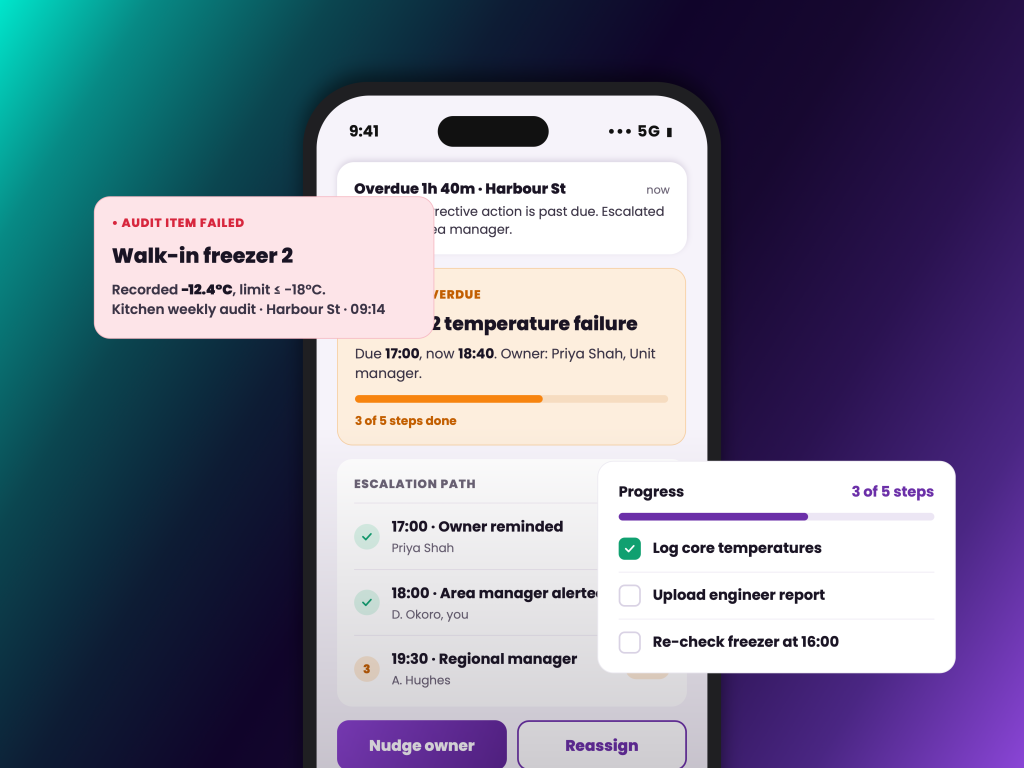
It’s the use of wireless sensors in chillers, freezers and cold stores to record temperatures automatically, around the clock, and alert the right people the moment a unit goes out of range. With mpro5 Sensor Hub, each alert also becomes a task for the team on shift, so the response and the corrective action are recorded alongside the readings.
What temperature should a food factory chiller be?
Most chilled product is held at 5°C (41°F) or below, and your HACCP or food safety plan sets the exact critical limit for each unit. Sensor Hub checks every reading against that limit and raises an alert as soon as it’s crossed.
How do you prove temperature control to a BRCGS or SQF auditor?
Auditors want continuous records, evidence that out-of-range readings were spotted and acted on, and the corrective action that followed. Sensor Hub keeps every reading and links each alert to the task that handled it, with who responded, when, the cause and photos of the stock, so the evidence is one search away.
What is the Free Exposure Analysis?
A 20 to 30 minute call where we look at how your sites would handle a failed or compromised chiller today, then show you where you’re exposed and what closes each gap. Your written report follows within five days, and it’s yours to keep whether you work with us or not.
What is Sensor Hub?
Sensor Hub is the part of mpro5 that connects your temperature sensors, keeps every reading, raises an alert the moment a unit goes out of range and turns it into a task for the people on shift. It lives in the same app as your checks, so the alert, the response and the proof all sit in one place.
Do we need new sensors?
Not necessarily. Sensor Hub works with sensors from a range of suppliers, so we can start with what you already have. If you have none, we’ll recommend options that suit your sites.
Would it still work if our refrigeration controls were hacked?
It depends how your sensors connect. Sensors that report over their own connection, rather than through the refrigeration controller, keep reporting. We’ll check yours on the call.
Who gets the alert after hours or at the weekend?
Whoever you decide, whether that’s the shift manager, the on-call technical manager or your refrigeration contractor. If they don’t pick it up, it goes to the next person on the list.
Does it replace our paper temperature logs?
Sensors take over the routine readings for every unit they’re fitted to, and the checks you still do by hand, like receiving temperatures, sit in the same app with the same record.
Can we start small?
Yes. You can start with your highest-risk cold stores, prove that the second view and the alert process work, and then roll out across your sites with the same onboarding team.
What does it cost to get set up?
Onboarding’s free. Our own team sets up your sensors, alerts and escalation with you and helps you roll out, so there’s no consulting bill before you see any value.